Oxfordshire £245.5M Transport Plan: What It Means for Homes
Oxfordshire’s £245.5M Transport Plan: What It Means for Your Commute, Your Street and Your Home’s Value
Oxfordshire County Council has approved a plan to spend £245.5 million of government funding on transport between 2026-27 and 2029-30 (Oxfordshire County Council). It covers potholes, buses, cycle routes, electric vehicle charging and road safety.
New stations and reservoirs get the headlines. But everyday improvements like these shape what buyers notice on a viewing: how easy the school run is, whether the bus turns up, and whether a street feels safe for children on bikes. This guide explains where the money is going and what it could mean for your next move.
The £245.5M plan in plain English
The Local Transport Delivery Plan (LTDP) sets out how the council will spend its consolidated government funding over four years. The cabinet approved it for submission to the Department for Transport in September 2026 (Open Council Network).
The funding covers five main areas (Oxfordshire County Council):
Road maintenance: repairs and preventative work.
Bus improvements: support for local services, ticketing, vehicles and passenger information.
Active travel: walking and cycling schemes, studies and infrastructure.
Electric vehicle infrastructure: delivery of the county’s EV strategy.
Vision Zero road safety: working towards no deaths or serious injuries on Oxfordshire’s roads by 2050.
It also funds a pilot to manage heavy goods vehicle movements and a new mobility hub in Benson to create a more sustainable local transport network.
The plan sits within the council’s wider Local Transport and Connectivity Plan, which aims for a net-zero transport network by 2040 (Open Council Network). The council will review the plan every year, and the government will publish the final version later this year.
Roads and potholes: the £167.9M maintenance programme
By far the largest single item is road maintenance. The structural maintenance programme is worth £197.7 million over 2026 to 2030. Of that, £167.9 million comes from this government funding and £29.8 million from the council’s own resources (LTDP Summary by Mode).
Even so, councillors say it is not enough. Councillor Liz Leffman, Cabinet Member for Highways, said there is “still a shortfall”, which is why council tax is also used to repair roads (Oxford Mail).
Why this matters for property: first impressions start before the front door. A potholed approach road or a crumbling pavement shapes how a buyer feels about a home before they have stepped inside. For sellers in villages on minor roads, planned resurfacing nearby is worth mentioning. For buyers, the council’s published programme can show which roads are due for work.
Buses, cycle routes and EV charging: what changes for commuters and families
Buses. The plan includes:
£14.9 million for continued support of enhanced local bus services.
£2.7 million for MyBus Oxfordshire ticketing systems.
Money for real-time passenger information screens and new local bus services (LTDP Summary by Mode).
For families without a second car, and for older buyers planning ahead, a reliable bus service can decide where they live.
Walking and cycling. The active travel delivery programme for 2027 to 2030 is worth £12.3 million. It comes on top of specific schemes already under way (LTDP Summary by Mode). The council has acknowledged that active travel funding has risen, though not to the level it had hoped (Oxford Mail).
EV charging. EV infrastructure has its own funding line. For buyers who drive an electric car, nearby public charging is now a common question, especially for homes without off-street parking.
Named schemes to watch
The council’s cabinet report lists the established schemes prioritised for 2026/27 (Cabinet report):
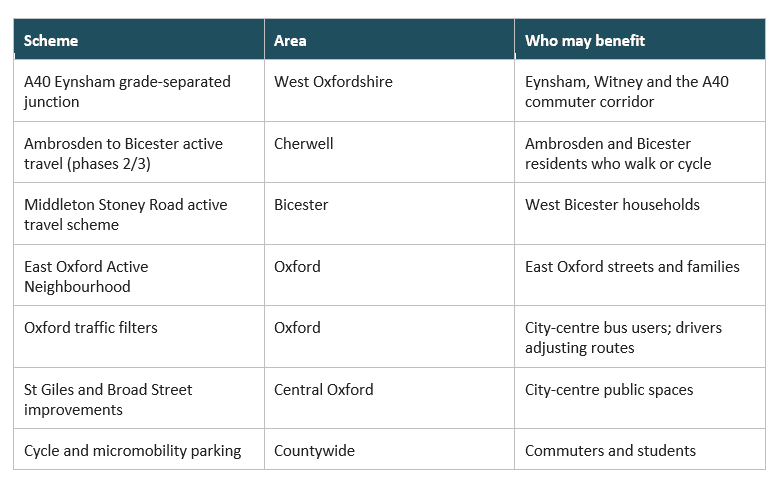
Add the Benson mobility hub in South Oxfordshire to that list (Oxfordshire County Council).
A note on traffic filters and low-traffic schemes: these divide opinion. Some buyers value quieter residential streets and easier cycling. Others are concerned about driving access. When you buy or sell on an affected street, be clear about how the scheme works and which routes are open.
How to use transport to choose, or sell, the right home
Viewing checklist for buyers
Do the commute at rush hour before you make an offer, whether by car, bus or bike.
Find the nearest bus stop and check how often buses run and whether real-time information is shown.
Look up the council’s planned schemes for the area. Planned improvements are a plus, and planned roadworks are worth knowing about.
Check EV charging if you drive electric and the home has no driveway.
Walk the school route. Safe pavements and crossings matter to families, and they are what Vision Zero funding targets.
Combine it with rail. Look at road and bus changes alongside the OxRail 2040 station plans covered in our previous article (OxRail 2040).
Listing checklist for sellers
State real travel times to key places: Oxford city centre, the nearest station, Harwell or Milton Park, and the A34 or M40.
Name bus routes and how often they run.
Mention nearby cycle routes, especially new or improved ones.
Highlight EV charging, either a home charger or nearby public points.
If a scheme is planned nearby, describe it accurately, for example “the A40 Eynsham junction scheme is in the council’s 2026/27 programme”.
Frequently asked questions
What is Oxfordshire’s Local Transport Delivery Plan? It is the county council’s plan for spending £245.5 million of government transport funding between 2026-27 and 2029-30. It covers roads, buses, active travel, EV infrastructure and road safety.
How much is being spent on Oxfordshire’s roads? The structural maintenance programme totals about £197.7 million over 2026 to 2030, of which £167.9 million comes from this funding. Councillors say a shortfall remains.
Do transport improvements increase house prices? Good connectivity is consistently one of the things buyers value most. Better buses, safer streets and new cycle routes can make an area more attractive. The effect varies from street to street and is not guaranteed.
Which Oxfordshire areas benefit from the plan? The named schemes include the A40 at Eynsham, Bicester (Middleton Stoney Road and Ambrosden), East Oxford, central Oxford and Benson. The road maintenance and bus funding applies across the whole county.
Talk to Oxford Property Consulting
Buying? Tell us your commute, your schools and your budget. We will shortlist Oxfordshire towns and villages that work for your daily life now and after these upgrades. Book a free location consultation.
Selling? Buyers are asking about buses, cycle routes and EV charging at viewings. Our pre-sale review makes sure your listing answers those questions before they are asked.
Information correct at the time of publication (19 November 2026). Scheme budgets and timings may change after the council’s annual review. This article is general information, not financial advice.